
Tibet Autonomous Region
Discover the evolution of this region through history.
 Évariste Huc
 China, an introduction
 Hebei
 Inner Mongolia
 Ningxia
 Gansu
 Qinghai
 Tibet
 Buddhism
 Behind the scenes
 The Quest for the Celestial Dragon
Thematic canvas
From the exhibition panel
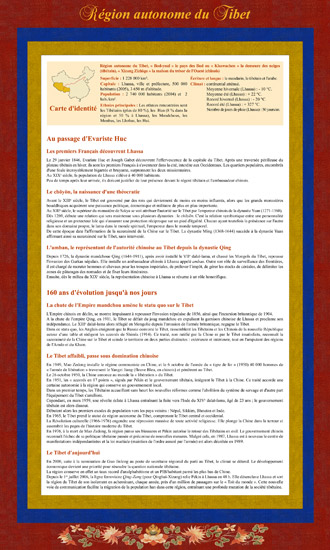
The text below is excerpted from the thematic canvas shown alongside it.
In Évariste Huc's footsteps — The first Frenchmen discover Lhasa.
On January 29, 1846, Évariste Huc and Joseph Gabet discover the bustle of Tibet's capital. After a perilous winter crossing of the Tibetan plateau, they become the first Frenchmen to venture into the city, then forbidden to Westerners. In the 19th century, Lhasa's population stands at 40,000.
Chöyön, the birth of a theocracy: in the 13th century, the head of Sakya monastery is granted authority over Tibet by the Yuan-dynasty Chinese emperor. It is a symbiotic relationship between a religious figure and a lay protector — the lama in the spiritual world, the emperor in the temporal one.
"We emerged into a broad valley, and to our right we caught sight of Lha-ssa, that famous metropolis of the Buddhist world. The multitude of age-old trees encircling the city like a girdle of foliage... all of it gives Lha-ssa a majestic and imposing air. It was January 29, 1846; eighteen months had passed since we left the Black Waters valley."
— Évariste Huc — Recollections of a Journey through Tartary and Tibet
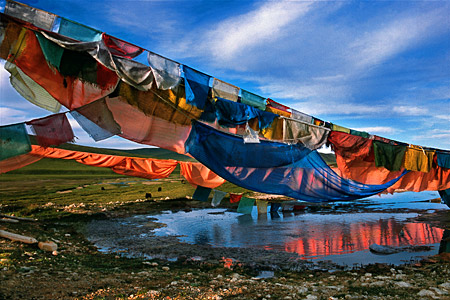
Prayer flags crowning a hot spring, at 4,600 m
The lungta ("wind horses") were introduced in the 11th century by the Indian Buddhist master Atisha. They are found atop mountain passes, on rooftops, and at village entrances.
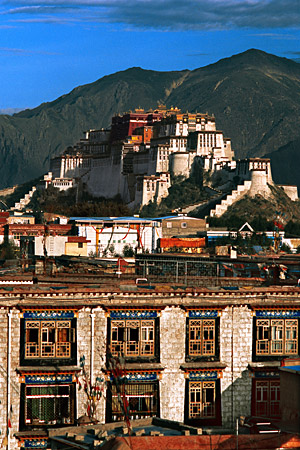
The Potala seen from Lhasa's old quarters
Budala Gong (in Chinese), Tsé Phodrang (in Tibetan): Tibet's most famous monument. Construction began in the 7th century under King Songtsen Gampo.
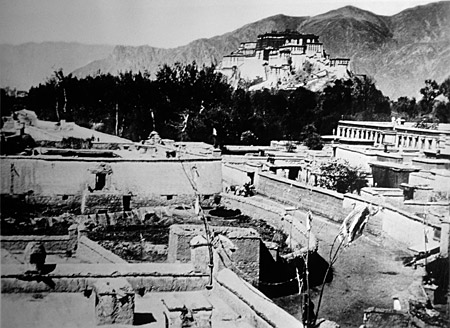
Photograph from the early 20th century (Paris Foreign Missions)
Eighteen months after leaving the Black Waters valley, Lhasa finally appeared, girded by its multitude of age-old trees.
"We emerged into a broad valley, and to our right we caught sight of Lha-ssa, that famous metropolis of the Buddhist world... all of it gives Lha-ssa a majestic and imposing air."
— Évariste Huc — Recollections of a Journey through Tartary and Tibet
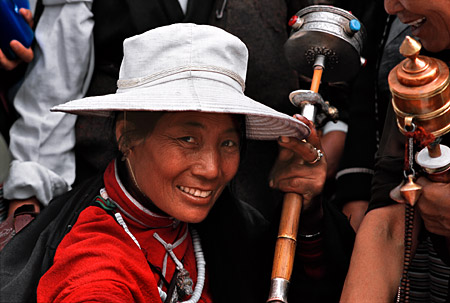
Tibetan woman around the Barkhor, in a street of Lhasa
Some pilgrims roll the beads of their long rosary between their fingers, or spin a small prayer wheel, the tchukor.
"There are several ways of making the pilgrimage around the lamaseries... Others are content to take a stroll, rolling the beads of their long rosary between their fingers."
— Évariste Huc — Recollections of a Journey through Tartary and Tibet
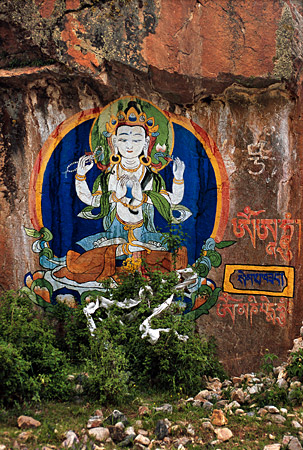
Depiction of the four-armed deity Avalokiteshvara, at Mang near Lhasa
Avalokiteshvara, called Chenrezig in Tibetan, "he who looks with the eyes of compassion," is one of the most popular deities of Tibetan Buddhism, the protective deity of Tibet.
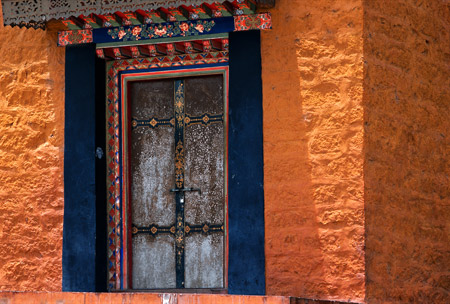
Drepung monastery, near Lhasa
Founded in 1416, Drepung ("rice heap") housed 8,000 monks before the Cultural Revolution. It shelters 500 today and remains one of the country's most active.
And 35 more photographs with captioned panels…