
Inner Mongolia Autonomous Region
Discover the evolution of this region through history.
 Évariste Huc
 China, an introduction
 Hebei
 Inner Mongolia
 Ningxia
 Gansu
 Qinghai
 Tibet
 Buddhism
 Behind the scenes
 The Quest for the Celestial Dragon
Thematic canvas
From the exhibition panel
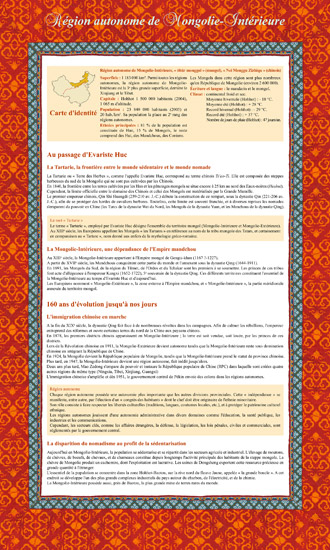
The text below is excerpted from the thematic canvas shown alongside it.
In Évariste Huc's footsteps — Inner Mongolia, a dependency of the Manchu Empire.
In the 13th century, Inner Mongolia belonged to the Mongol Empire of Genghis Khan (c. 1167-1227). From the 17th century, the Manchus conquered this part of the world and annexed it under the Qing dynasty (1644-1911).
In 1691, the southern Mongols (of the Tümed, Ordos and Chakhar regions) were the first to submit, pledging allegiance to Emperor Kangxi (1652-1722), fifth ruler of the Qing dynasty. These territories make up the essential part of Inner Mongolia both in Évariste Huc's time and today.
Europeans call "Outer Mongolia" the zone outside the Manchu Empire, and "Inner Mongolia" the annexed southern part of Mongol territory.
"The deserts of Tartary are generally so treeless and so monotonously bare that one cannot help feeling a certain relief upon encountering, now and then, a few trees along the way."
— Évariste Huc — Recollections of a Journey through Tartary and Tibet
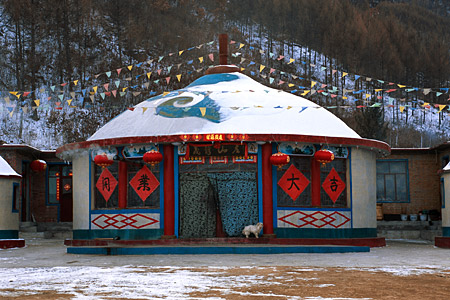
A modern Mongolian yurt, on the Hebei border
Some Mongols in the region, as they settle, build their homes on the traditional yurt model — in Mongolian, ger, a word that has since entered everyday usage abroad.
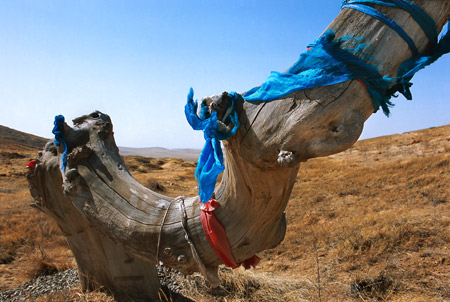
Sacred shamanic tree standing alone in the Gobi desert
A lone tree, a ritual offering amid the desert's vastness — a rare and meaningful landmark for travelers of the steppe.
"The deserts of Tartary are generally so treeless and so monotonously bare that one cannot help feeling a certain relief upon encountering, now and then, a few trees along the way."
— Évariste Huc — Recollections of a Journey through Tartary and Tibet
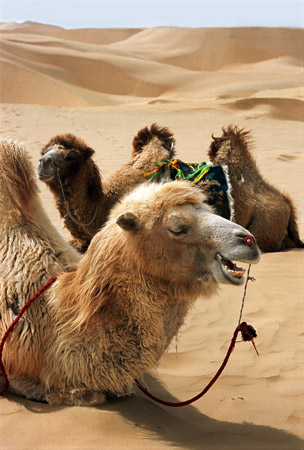
Bactrian camels in the Ordos desert
Domesticated 4,500 years ago in Bactria (in today's northern Iran), the Bactrian camel was brought to China via the Silk Road 2,500 years later.
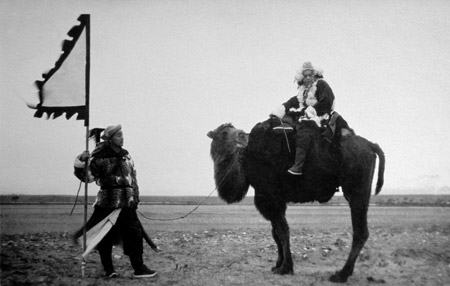
Photograph from the early 20th century (Congregation of the Lazarist Mission of Paris)
A true treasure of the desert, the camel can go fifteen days or even a month without food or water, carrying up to 400 kg over some ten leagues a day.
"The camel, whose robust and hardy temperament adapts to the most barren mountains, makes up for the hardships of the Ortous Tartars. This animal, a true treasure of the desert, can go fifteen days and even a month without drinking or eating."
— Évariste Huc — Recollections of a Journey through Tartary and Tibet
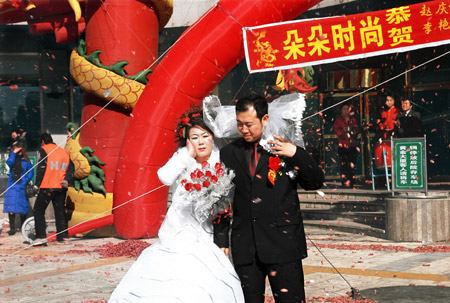
A modern wedding
More than 10 million people marry each year in China; over 250 billion yuan are spent annually in a booming wedding industry.
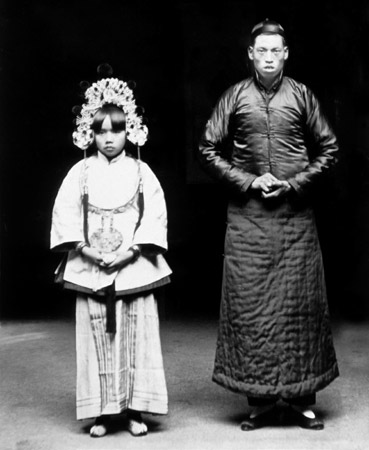
Photograph from the early 20th century (Congregation of the Lazarist Mission of Paris)
It was often the case that parents made marriage arrangements before the future spouses were even born.
"The Chinese marry very young... Nothing is more common than concluding marriages long before the parties have reached puberty. It even often happens that parents make commitments before the future spouses are born."
— Évariste Huc — The Chinese Empire
And 14 more photographs with captioned panels…