
Beijing Municipality and Hebei Province
Discover the evolution of these two regions through history.
 Évariste Huc
 China, an introduction
 Hebei
 Inner Mongolia
 Ningxia
 Gansu
 Qinghai
 Tibet
 Buddhism
 Behind the scenes
 The Quest for the Celestial Dragon
Thematic canvas
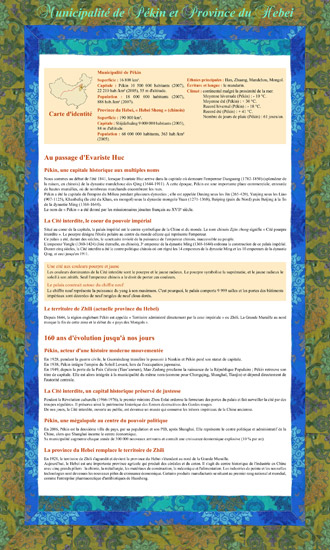
From the exhibition panel
The text below is excerpted from the thematic canvas shown alongside it.
In Évariste Huc's footsteps — Beijing, a historic capital with many names.
It is the beginning of summer 1841 when Évariste Huc arrives in the capital, home to Emperor Daoguang (1782-1850) ("Splendor of Reason," in Chinese) of the Manchu Qing dynasty (1644-1911). At the time, Beijing is a major trading hub, surrounded by high walls, its streets crowded with merchants.
Beijing was the Middle Kingdom's capital under several dynasties: called Daxing under the Jin (265-420), Yanjing under the Liao (907-1125), Khanbaliq ("the Khan's city," in Mongolian) under the Mongol Yuan dynasty (1271-1368), Beiping ("northern peace," in Chinese) then Beijing ("northern capital," in Chinese) at the end of the Ming dynasty (1368-1644). The name "Peking" was given by French Jesuit missionaries in the 17th century.
"The camel, whose robust and hardy temperament adapts to the most barren mountains... In several regions of Tartary they pull the carriages of kings and princes; sometimes they are also harnessed to palanquins, but only in flat country."
— Évariste Huc — Recollections of a Journey through Tartary and Tibet
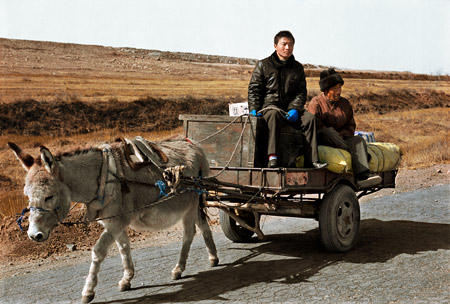
A typical means of transport in the countryside
Today, only 1 in 20 Chinese people owns a private motor vehicle (152 million in 2006), including 13 million cars.
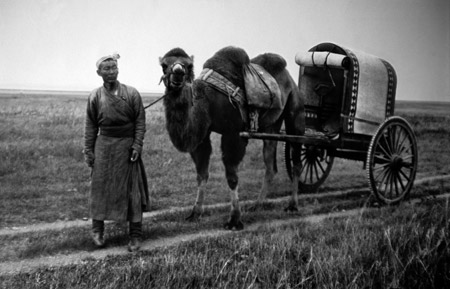
Photograph from the early 20th century (Paris Foreign Missions)
In several regions of Tartary, camels pulled the carriages of kings and princes, sometimes harnessed to palanquins — but only in flat country.
"The camel, whose robust and hardy temperament adapts to the most barren mountains... In several regions of Tartary they pull the carriages of kings and princes; sometimes they are also harnessed to palanquins, but only in flat country."
— Évariste Huc — Recollections of a Journey through Tartary and Tibet
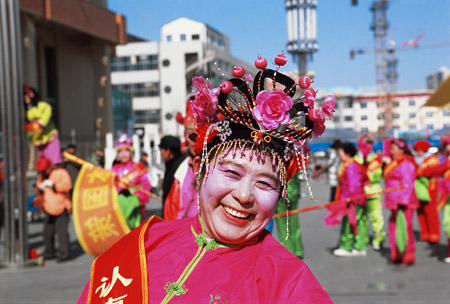
Dancer in a folk parade
This colorful, musical event is held regularly on the main square of the city of Chifeng. The roots of Chinese folklore trace back to the Qin dynasty (221-206 BCE).
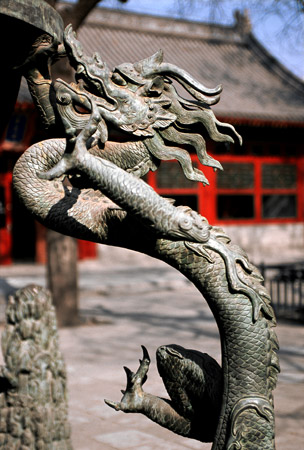
Detail of an astronomical instrument at Beijing's old observatory (Beijing Guan xian tai)
Made in 1442, this bronze instrument was used to track the position of the stars. Chinese culture features many symbolic animals such as the dragon (huangdi, in Chinese), a symbol of good fortune, fertility and vital energy.
And 19 more photographs with captioned panels…