
Ningxia Autonomous Region
Discover the evolution of this region through history.
 Évariste Huc
 China, an introduction
 Hebei
 Inner Mongolia
 Ningxia
 Gansu
 Qinghai
 Tibet
 Buddhism
 Behind the scenes
 The Quest for the Celestial Dragon
Thematic canvas
From the exhibition panel
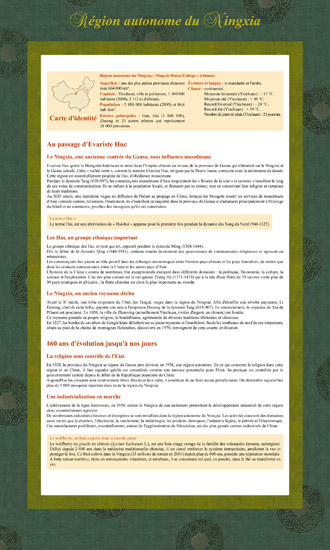
The text below is excerpted from the thematic canvas shown alongside it.
160 years of change to the present day — Religion under state control.
In 1928, Ningxia province separated from Gansu, then became an autonomous region in 1958. Religion is viewed as a potential threat to the state; its practice has been controlled by the central government since the founding of the People's Republic. Today believers are relatively free to practice, provided they do not proselytize — the region counts over 3,000 mosques.
Industrialization under way: in 1958, the completion of the railway line pulled Ningxia out of its isolation, enabling the industrial development of a region that had been mostly agricultural. Coal, electricity, machinery, metallurgy, chemicals, oil and electronics proliferate mainly around Shizuishan, one of China's largest industrial centers.
"At any hour of the day or night, numerous mobile restaurants carry every kind of dish: soups, mutton and beef stews, vegetables, pastries, rice, vermicelli. These vendors come and go, succeeding one another almost without interruption. They usually belong to the Muslim community."
— Évariste Huc — The Chinese Empire
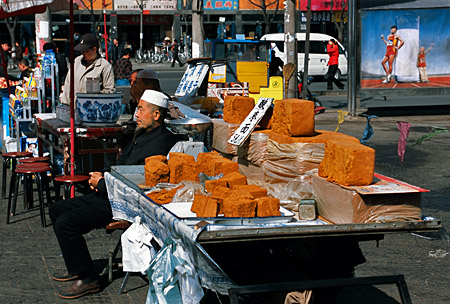
Hui merchant selling noodle condiments
The Hui hold a major place in the region's economy. This ethnic group is one of China's largest, numbering close to 10 million people.
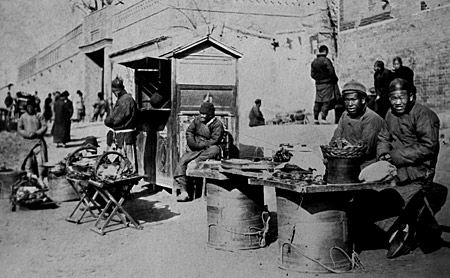
Photograph from the early 20th century (Congregation of the Lazarist Mission of Paris)
Mobile restaurants carried soups, stews and pastries at any hour of the day or night, usually run by members of the Muslim community.
"At any hour of the day or night, numerous mobile restaurants carry every kind of dish: soups, mutton and beef stews, vegetables, pastries, rice, vermicelli."
— Évariste Huc — The Chinese Empire
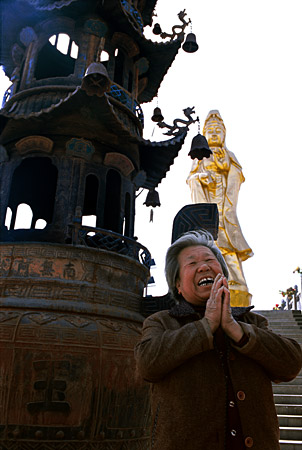
Prayers at the Yuhuang Taoist temple, Pingluo
Founded by Laozi (6th century BCE), Taoism views human desires as positive and encourages embracing life, in a quest for harmony with nature.
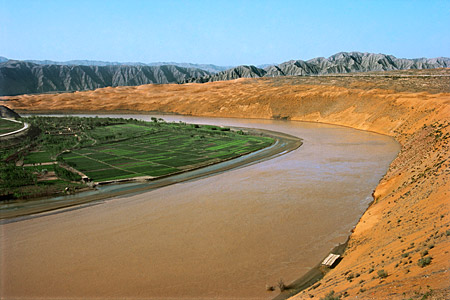
Shapotou, where the Tengger Desert meets the Yellow River
This oasis, nicknamed the "green belt," is hemmed in by two deserts (Tengger, Ordos) and the imposing Helanshan mountain range.
"At every step our camels sank in up to their bellies, and it was only in fits and starts that they could move forward... we had to be very careful not to tumble down these mountains, right into the Yellow River."
— Évariste Huc — Recollections of a Journey through Tartary and Tibet
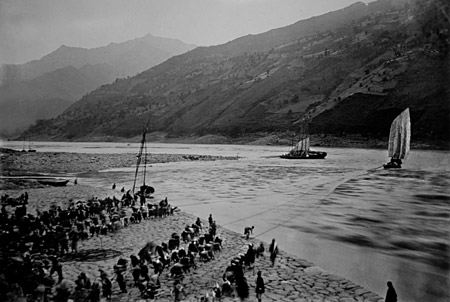
Photograph from the early 20th century (Paris Foreign Missions)
The Yellow River rises in the mountains of Tibet and crosses Koko Nor before entering China through Gansu province.
"The moon was bright, lighting up this immense river, which rolled its yellowish, turbulent waters over flat, even ground. The Hoang-ho is, without question, one of the finest rivers in the world."
— Évariste Huc — Recollections of a Journey through Tartary and Tibet
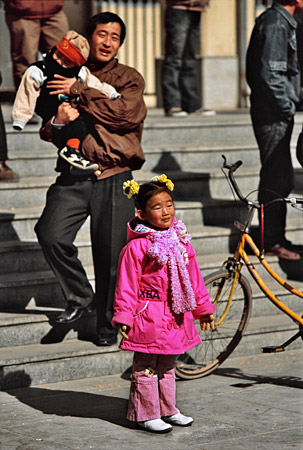
Childhood
China's birth rate stood at 13.46% in 2006, down from 35% in 1970 — a consequence of the "one-child" policy, now relaxed in major cities.
And 5 more photographs with captioned panels…